Algerian director Ali Aissaoui awarded “Golden screen 2008†for “Hello Constantineâ€

الشروق أونلاين
-
-
2318
-
0
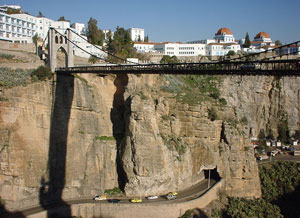
Constantine, east of Algeria
Algerian director Ali Aissaoui was awarded the 2008 Golden screen by the Algerian television for his work “Hello Constantineâ€.
-
“Constantine, known for its amazing history and geography wins the price,” said Ali Isaaoui.
-
-
“This award comes after efforts by photographers, especially director of photography Mourad Boughira, photographer Omar Khaznadar and specialist in installation Faouzi Banini. I have chosen this team because it contains consistent elements who like the collective work and intimate atmosphere that are important factors in the success of any work,” he added.
-
-
“Hello Constantine” also won the second price at the Arab Contest of radios and televisions organized in Tunisia November 6 with the participation of a big number of Arab works.
-
Ali Issaoui already won the “Golden Screen 2000 & 2001” for his TV work “Summer in Algeria”. Since 1984 he realized 600 productions in theatre, arts and portraits, in addition to other live sport events and documentaries.
-
-
In his work “Hello Constantine”, Director Ali Aissaoui chose the image of Constantine under the rain in spring times and presented a geographic and historical view of Algeria’s northern regions using the Algerian “Malouf” music to attract visitors and tourists.
-
-
Bridges and theatre of Constantine got the most important part time of description 52mn.
-
-
The capital of eastern Algeria, Constantine has a population of over 500,000 (750,000 with the agglomeration), making it the third largest city in the country after Algiers and Oran.
-
-
- The city was originally settled by Numidian people, and was known as Sarim Batim. Later its name was Cirta, thought to be from the Phoenician word for “city”, but originates in fact from “Thacirth” which is an Imazighen (Berber) word for a traditional wheat grinder made of stones (due to the stony look of the city). Constantine was capital city of the Numidia, a berber empire that emerged in the 3rd century BC. The city was founded in 203 BC by king Micipsa, with the help of Greek colonists. She distinguished for the splendor of the public buildings and its population overcame that of all other towns of northern Africa. It had an army of 10,000 cavalry and 20,000 infantry. In 113 BC the town was conquered by Jugurtha. Later it served as base of the Roman generals Caecilius Metellus Numidicus and Caius Marius. In 107 BC the latter gained a victory over Jugurtha in the nearby of Cirta. With the suppression of king Juba I and the rest of the supporters of Pompey in Africa (46 BC), Julius Caesar gave special civil rights to a part of Cirta, under the name of Sittlanorum Colonia. It became the head of a confederation of four similar settlements in North Africa.
- In 311, during the civil war between emperor Maxentius and usurper Domitius Alexander (former governor of Africa), the city was destroyed. Rebuilt in 313, it was subsequently named after Emperor Constantine the Great, who had defeated Maxentius. Conquered by the Vandals in 432, Constantine returned to the Byzantine exarchate of North Africa from 534 to 697. It was conquered by the Arabs in the 7th century, receiving the name of Qusantina.
- The city recovered and in 12th century was again a prosperous market, with connection to Pisa, Genoa and Venice. Since 1529 it was intermittently part of Ottoman Empire, ruled by a Turkish Bey (governor) subordinate to the Dey of Algiers. Salah Bey, who ruled the city in 1770-1792, greatly embellished it and built much of the Muslim architecture still visible today.
-
In 1826 ,the last Bey, Ahmed Bey ben Mohamed Chérif became the new head of state and led a fierce resistance against French occupation forces. By 13 October 1837 the territory was reconquered by France, and in 1848 it was incorporated into the colony of Algiers (Algeria).
- In World War II, during campaign in North Africa (1942-43), Constantine and the nearby city of Sétif were used by the Allied forces as operational bases.
-
Constantine is native city of the Islamic reformator Ben Badis. It is also the hometown of Key people in Algeria and the world.
- Ben Badis, (Islamic reformer and philosopher)
- Masinissa The first King of Numidia.
- Princess Charlotte, Duchess of Valentinois, the daughter of Louis II, Prince of Monaco, and the mother of Prince Rainier III
- Hassiba Boulmerka, Athlete World and Olympic Champion she is the first Algerian to win an Olympic title.
- Ahlam Mosteghanemi (writer)
- Ahmed Bey (the Last Bey of Constantine).
- Rabah Bitat war hero and speaker of parliament
- Kateb Yacine (writer).
- Ali Saidi-Sief (Olympic runner sub Champion in 2000 Summer Olympics ( 5000 m)